
Showing posts with label Images. Show all posts
Showing posts with label Images. Show all posts
28.12.17


19.12.17


28.11.17

12.11.17

30.10.17

25.10.17


13.10.17

9.10.17
Dog Talk: We Had a Great Ride [9-10-17]

Dog Talk: We Had a Great Ride
Matthew “Uncle Matty” Margolis
One of my dear friends recently lost their beloved dog. I encouraged her to share her experience in words, and she did:
It's been three weeks since my dog died. When I realized that just now, I made a quick and quiet wish that time would stop. Or better, reverse. I don't want to be any further from the time when he was still breathing, still working that sniffer, still soft and warm in my arms. I don't want it to be real.
Some call it self-indulgence. I call it grief.
I resent the clock and its relentless ticking. Time moving on. The earth spinning. The sun setting. The moon smiling, taunting. The only thing that feels good is the rain. Seems right. Some acknowledgment from the world that mine has forever changed. A nod from Mother Nature.
He was just a dog.
And I am just a woman. Why is the death of a person more important, more profound? Why is it supposed to be felt deeper? Is it because we put a man on the moon? Because we invented the wheel and took flight, tamed fire and electricity, created a new universe of sorts with the Internet and kept 33 men alive half a mile underground for 69 days?
That's the anger talking.
It's all very impressive, the accomplishments, the developments. But impressive doesn't make you feel like skipping.
That's the truth.
Percy Burtch was born on March 1, 1996, the smallest of a litter of six dachshund/beagle/Chihuahua pups. My roommate at the time plucked him from the bed of a pickup truck somewhere on the outskirts of Austin, Texas. On a college-girl whim, she brought Percy home to our apartment that didn't allow dogs.
On that very ordinary day, everything changed.
It was clear from the beginning that Percy was, in a word, unusual. He was alternately standoffish and playful. Shy and bossy. Sweet and sour. Jekyll and Hyde. Even as a puppy, he gave the impression of having deeply entrenched opinions on the life he should be living, the company he should be keeping, the things he should be doing, eating, playing with, gnawing on. My roommate decided she couldn't hack it and put an ad in the paper: "Adorable puppy -- free!"
He was adorable. But I feared she and the ad would mislead Percy's next owner, making it likely he'd end up being passed off to yet another home or dumped at a shelter. As the voice mails came in responding to the ad, I deleted them. All of them. There was no way this handsome pup with the deep brown eyes was going to suffer that fate. I was in love.
I learned so much trying to figure that dog out. The two of us being of German stock, we were stubborn and butted heads. I was young, impatient and still indulging my desires for instant gratification and anything that felt good. He was food-aggressive, hyper-territorial, resistant to my amateur attempts at training -- a total Alpha nightmare.
But the good trumped the bad, and I smelled potential. He was remarkably smart and curious, not to mention exceedingly loyal and protective. He chased away more than a handful of unsavory characters. He prevented a break-in while I was home alone. He made me feel safe when my peace of mind had been assaulted. He made me feel like skipping.
Over the next 14 years, Percy and I reached an understanding. And I learned three very important things: 1) A good walk has the power to erase bad will. 2) It's vital to stop and sniff. Often. 3) There's nothing like a road trip to cure what ails you.
I've done two things in the past two months of which I'm very proud:
When it became clear that Percy's time would be shorter than expected, I cleared my calendar as best I could and we hit the road. I will never forget the toothy, tongue-dangling grin on his face as we crossed the Continental Divide together for the umpteenth time.
And two weeks later, when it was obvious that Percy's kidneys would not rebound, that his quality of life was not what he deserved, was not what I wanted for him or would want for myself, I asked his vet, an exceptionally kind and compassionate man, to come to the house to administer an injection that would end my little guy's suffering. And he did.
Rest in peace, sweet Percy. We had a great ride.
8.8.17
Dog Talk: Old Dog, New Trick

Dog Talk: Old Dog, New Trick
A lady called me a few weeks ago and said, “Matty, can you help me? I have a dog that’s 12 and needs to be housebroken.”
“Twelve weeks?” I asked.
She shook her head.
“Months?”
“Years,” she said.
That’s right — years.
My question, naturally: Why did you live with this problem for so long?
Her answer: I thought nothing could be done. I just accepted it as a way of life until one day I thought, no harm in asking.
As for the answer to her question, “Matty, can you help me?” I had her dog fully housebroken in one visit. It’s the easiest thing in the world to do if you know what you’re doing. You don’t have to live with this kind of stress and chaos. Education is the way out.
I wanted to share this story with you to illustrate only one point: You can teach an old dog new tricks.
So many people give up on older dogs without ever giving them a chance. A trained — a.k.a. educated — dog is a joy at any age. But sadly, shelters are full of 9- and 10-year-old dogs abandoned by their families because of behavioral problems that are entirely solvable! It’s one of the saddest and most frustrating realities of my line of work.
There are two myths about older dogs. One is that once they reach a certain age, if they don’t already know something, they’re never going to. As we learned from this woman’s experience: Wrong.
The other is that you can avoid “puppy problems” if you adopt an older dog. Maybe, maybe not. If an 8-year-old dog has never been educated, he won’t know anything more in terms of human expectations than an 8-week-old dog. Dogs don’t know what “come here” means unless we teach them. How could they? They’re dogs.
That simple statement sometimes feels like the biggest hurdle of all — getting people to understand that their dog is, indeed, a dog. He’s not a person. He’s not a plant from Home Depot. He’s a dog, and he comes with his own set of challenges and his own many rewards. But the great part is, when tackled from the get-go in the right way, your relationship with your dog can become one of the great friendships of a lifetime.
Not long after that woman’s call, a man called me and grumbled, “I got this dog, and there’s something wrong with him.”
I asked, “What’s wrong with him?”
“He won’t come.”
“Why not?”
“Not sure.”
“Is he trained?”
I’ll let you guess the answer.
Then there’s the woman with the blind, 11-month-old Yorkie that’s driving her nuts. The dog barks. She yells. The dog barks some more. … If yelling worked, I’d be in the yelling business. Very little overhead in the yelling business.
All of the people I’ve mentioned so far were living with unnecessary frustrations and missing out on the good stuff! A dog at any age is trainable. It’s best to teach them while they’re young, but it’s never too late. Please believe me when I say 95 percent of behavioral problems are entirely manageable, if not completely erasable. The solution is education. Love him, yes. But teach him! Train him! Love can’t be the only ingredient when trying to build a long-lasting, healthy, functional relationship with your pooch. You have to teach him how you want him to behave, show him what you want him to do, guide him through the motions and reward him for a job well done. Love, praise and affection are all part of a good education.
So this holiday season, if you’re thinking about adopting an older dog, that’s wonderful because there are so many in need of and deserving of good homes. But if you’re thinking about adopting an older dog because you think he won’t come with all those nasty “puppy problems,” don’t sign on the dotted line too quickly. Do your homework. Get to know your potential pup. Animals are the single greatest impulse purchases in the world — which is understandable, but can nevertheless lead to problems for both of you down the line.
My holiday wish is that people wouldn’t take animals home with them without a true commitment. If I could have two wishes, the second would be that getting the pooch trained would become as natural an inclination as sending the kid to school. For more information on dog training or solving behavioral problems, visit unclematty.com.
Woof!
6.8.17
Simple Steps for a Happier, Healthier Dog

Simple Steps for a Happier, Healthier Dog
For some time now there have been various health trends that people follow. Some are good, while many are not. Many of these trends are simply a good way for someone to make some really good money off of peoples desperation to be healthy. There are always new diets to follow, new artificial sweeteners, and new methods for a achieving a healthy lifestyle.
While all this is taking place, a similar trend is beginning to take place with dogs. It seems nowadays that everyone has a new doggie diet to put your faithful canine companion on.
Again, not everything people recommend is good. I have found in my years studying health that it is usually very simple things that you can do that have the greatest results. The same applies to your dog.
Let us go through some simple ideas that will have a great impact on your dogs health, and should grant them a long them a longer healthier life. These things may seem rudimentary, but as I said the simple things that people most often overlook are the things that work best.
Lets start with their diet. If you are feeding your dog table scraps stop it. For one thing, a lot of the common foods we eat on a daily basis are not good for dogs. For instance, studies have been done that prove grapes can make some dogs sick causing potential kidney failure, vomiting or diarrhea.
Dogs need to eat a healthy diet full of protein and healthy meats. They are carnivores aren't they. Some vegetables are OK in moderation, but you need to research before you feed your dog these things. Under no circumstances give them junk food. We shouldn't be eating it either. Peanut butter, carob, and yogurt are OK in moderation as well.
The occasional dog treat is OK, but make sure they are made from all natural ingredients. You also want to make sure your dog drinks filtered water, and takes an all natural supplement to support healthy function. There are some really good ones out there if you research. You can find supplements and vitamins that help with dog obesity, joint problems, and general supplementation for better health
Next, you want to make sure your dog gets plenty of good quality rest. This can start by spending a little bit more money and getting them a nice bed to sleep on. There is a great variety of nice dog beds to choose from if you know where to look. You can find everything from simple mats, to gorgeous masterpieces that will even rival your bed in terms of elegance and quality.
Make sure your dog gets plenty of exercise. Give your pooch some good quality dog toys to play with. Give them some variety and see which king of toys keep them busy the longest. I have found that the hard rubber ones with the hollow spot for treats will keep them busy for a long time, especially if you put a couple of small treats inside.
Try some good fetch toys, and take a few minutes each day with them playing and interacting with them. A few minutes a day means a great deal to your loyal four legged companion. Simply put, make sure to spend some time loving on them each day. Following these simple tips will do wonders for the health of your dog.
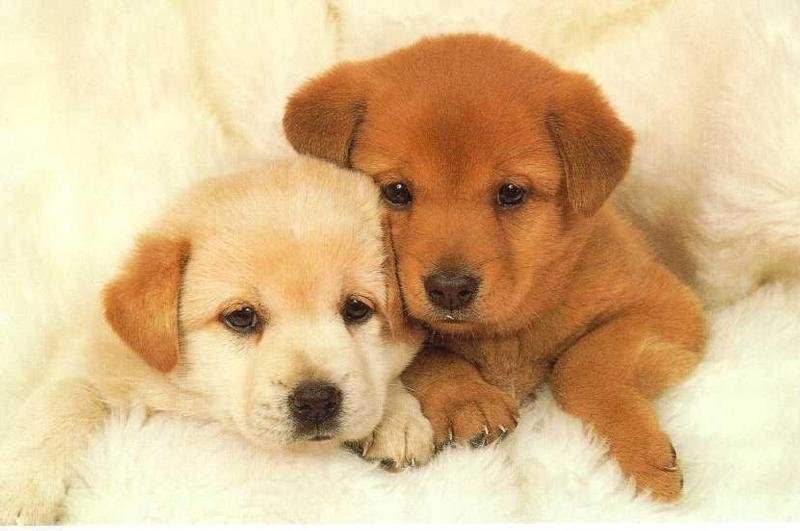

19.5.17
Talking Dogs: How to take care of brand-new puppies

Talking Dogs: How to take care of brand-new puppies
When welcoming a new puppy into your life, you may think you are starting with a "blank slate," but this is not the case.
There is a lot happening in a puppy's world, and a lot that should happen during those first few weeks of life to give you the best chances of raising a valued member of your family.
From birth to 12 days of age -- the neonatal period, a puppy can't hear or see. It can't eliminate waste by itself or regulate its body temperature. It is dependent upon its mother for food, warmth and survival. Daily human handling is thought to better prepare the puppy for stresses later in life.
The transitional period, lasting about two weeks and beginning around the 13th day of life, is when the puppy's senses rapidly mature. Both the eyes and ears open, and the puppy learns how to walk. Humans should gently expose the puppy to all types of stimuli during this time (objects, sounds, varied surfaces, etc.) to enhance development. It is imperative that the puppy remain with its mother and littermates in a calm and stable environment.
Around 1 month of age, the puppy enters into the first socialization period, which lasts up until the 12th week of life. During this time, social behavior and patterns are developing, largely through the interaction with littermates and the mother. This is a critical time in the puppy's temperament and behavior development and greatly affects how it will behave as an adult dog. It begins to investigate its surroundings, and gradually shifts its interaction away from its mother and more toward its littermates. Through play, the puppy learns not to bite too hard and the specifics of chasing, barking and body posturing, including submissive postures. This is also a time when the puppy startles easily and fearful responses become much more pronounced. Exposure to different environments, objects, sound and surfaces should continue; in time, the puppy will learn to discriminate between truly dangerous situations and those that are of no concern.
It is a widely accepted rule that no puppy should leave its litter until the 49th day of life. Generally speaking, the best time to bring a new puppy home is between 7 and 9 weeks of age. If your new puppy has been raised in a calm environment, with littermates and daily human handling and exposure, the job of house-training and raising the puppy should be a fairly easy task. But continued exposure to a variety of people, other friendly animals, including dogs, surfaces, noises, objects, car rides and a host of other everyday scenarios are imperative to ensure you raise a well-adjusted, temperamentally sound adult dog.
Note that none of the above has anything to do with "training." How your puppy is raised and treated its first few months of life will greatly impact how easy -- or difficult -- the training process is. Knowing the particulars of how your puppy was raised before bringing it home is important information and should be factored in to selecting your new dog. While raising and training a puppy that has not had a good start in life -- as often is the case when adopting a puppy from a shelter, or rescuing one off the street -- is still possible, it helps to know that it may be a far more challenging process.


3.5.17
Pet Microchips - A Do or a Don't? [3-5-17]

Pet Microchips - A Do or a Don't?
If you are worried about losing your pet, new technology allows for biologically safe microchips to use in the place of, or in addition to the classic dog tags. Microchips are an excellent option for a form of identification, and it is rapidly becoming popular in families throughout the country. Here are a few answers to common questions people might ask in relation to the use of these microchips.
What exactly is a microchip? A microchip is a small device that is comparable in size to a grain of rice. This device has a special identification number that helps animal shelters and local humane societies get in touch with the pet's owner.
How does this microchip work? As stated earlier, a microchip has a specific I.D. number, which allows shelters and humane societies get in touch with the pet's owner. The I.D. number is transmitted through an all-purpose handheld scanner, which relays the number to a computer screen. The handheld device transmits radio waves at a frequency of 125 kHz, which is completely safe and non-harmful to your pet. Depending on the brand of the microchip (the two most common brands are AVID and HomeAgain), the animal shelter or humane society will go to the registered microchip databases, and they will either contact you or the microchip company should your pet be found.
Where do they place this microchip? On cats and dogs, the microchip is placed in the fleshy part between the shoulder blades on their back. They cannot feel the microchip, and once it is in, it should give them no problems.
Could my pet have an allergic reaction to a microchip? It is highly unlikely. The microchip is made out of an outer shell of extremely tough glass, and has safe biological contents inside. Because of the way the chip is made, your pet will quickly develop connective tissue that keeps the chip in place.
How is the microchip inserted? The microchip is simply administered like a shot. Though the syringe may be slightly larger than that of a common vaccine shot, it will not hurt any more or any less. Your pet will not react any differently than they would if they were receiving a routine shot. Anesthesia is not necessary, nor is it recommended for this procedure.
What kind of animals can be microchipped? Almost any animal! The most common uses are dogs, cats, birds, horses (other livestock, such as pigs, sheep, or cows), and even fish! Many farmers or animal breeders microchip their animals as an easy form of identification; this takes the place of branding or tagging.
You never know when a natural disaster may befall your area. With hurricane Katrina and earthquakes, many animals have been misplaced and lost their homes. With the aid of a microchip, thousands of pets have been reunited with their loving families. Microchips are safe, beneficial, and the cost is definitely worth the security of knowing your pet has a chance of being found should they become lost.

Subscribe to:
Posts (Atom)